Online first
Bieżący numer
O czasopiśmie
Archiwum
Polityka etyki publikacyjnej
System antyplagiatowy
Instrukcje dla Autorów
Instrukcje dla Recenzentów
Rada Redakcyjna
Bazy indeksacyjne
Komitet Redakcyjny
Recenzenci
2025
2024
2023
2022
2021
2020
2019
2018
Kontakt
Klauzula przetwarzania danych osobowych (RODO)

PRACA POGLĄDOWA
Mikroplastik jako środowiskowy czynnik zaburzający gospodarkę hormonalną i metaboliczną człowieka
1
1. Wojskowy Szpital Kliniczny z Polikliniką Samodzielny Publiczny Zakład Opieki Zdrowotnej w Lublinie
2
Independent Public Healthcare, General Hospital, Łęczna, Poland
3
Samodzielny Publiczny Zakład Opieki Zdrowotnej w Puławach (SPZOZ w Puławach)
4
Wojskowy Instytut Medyczny – Państwowy Instytut Badawczy
5
Szpital Bielański im. ks. Jerzego Popiełuszki SPZOZ
ul. Cegłowska 80, 01-809 Warszawa
6
Mazowiecki Szpital Specjalistyczny w Radomiu
7
Samodzielny Publiczny Szpital Kliniczny Nr 4 w Lublinie
Uniwersytecki Szpital Kliniczny Nr 4 w Lublinie
8
Międzyleski Szpital Specjalistyczny w Warszawie
Autor do korespondencji
Laura Maria Surdacka-Barańska
1st Military Clinical Hospital with Polyclinic, Independent Public Healthcare Institution, Lublin, Poland
1st Military Clinical Hospital with Polyclinic, Independent Public Healthcare Institution, Lublin, Poland
Med Srod. 2026;29(2):47-54

SŁOWA KLUCZOWE
DZIEDZINY
STRESZCZENIE
Wprowadzenie i cel:
Mikroplastik stanowi powszechnie występujące zanieczyszczenie środowiskowe, którego potencjalny wpływ na zdrowie człowieka jest przedmiotem rosnącego zainteresowania. Ze względu na niewielki rozmiar i właściwości fizykochemiczne cząstki mikroplastiku mogą przedostawać się do organizmu głównie drogą pokarmową i inhalacyjną, przy czym zostały wykryte w kilku matrycach biologicznych człowieka. Celem pracy było podsumowanie aktualnej wiedzy dotyczącej indukowana przez mikroplastik zaburzeń układu endokrynnego i ich potencjalnych konsekwencji metabolicznych.
Opis stanu wiedzy:
Dostępne dane wskazują, że mikroplastik może wpływać na funkcję układu endokrynnego poprzez stres oksydacyjny, sygnalizację zapalną, interakcje ze związkami endokrynnie czynnymi oraz zaburzenie wewnątrzkomórkowych szlaków regulujących syntezę hormonów. Badania eksperymentalne ukazują jego wpływ na steroidogenezę, sygnalizację insulinową, skład mikrobioty jelitowej i funkcję tkanki tłuszczowej. Mechanizmy te mogą oddziaływać na główne osie hormonalne, w tym HPA, HPT i HPG, oraz sprzyjać zaburzeniom metabolizmu glukozy i lipidów.
Podsumowanie:
Aktualne dane sugerują, że mikroplastik może modulować procesy endokrynne i metaboliczne. Bezpośredni związek przyczynowy między ekspozycją na mikroplastik a chorobami endokrynnymi lub metabolicznymi u ludzi nie został jednak potwierdzony. Konieczne są dalsze badania z użyciem wystandaryzowanych metod analitycznych i klinicznie istotnych punktów końcowych.
Mikroplastik stanowi powszechnie występujące zanieczyszczenie środowiskowe, którego potencjalny wpływ na zdrowie człowieka jest przedmiotem rosnącego zainteresowania. Ze względu na niewielki rozmiar i właściwości fizykochemiczne cząstki mikroplastiku mogą przedostawać się do organizmu głównie drogą pokarmową i inhalacyjną, przy czym zostały wykryte w kilku matrycach biologicznych człowieka. Celem pracy było podsumowanie aktualnej wiedzy dotyczącej indukowana przez mikroplastik zaburzeń układu endokrynnego i ich potencjalnych konsekwencji metabolicznych.
Opis stanu wiedzy:
Dostępne dane wskazują, że mikroplastik może wpływać na funkcję układu endokrynnego poprzez stres oksydacyjny, sygnalizację zapalną, interakcje ze związkami endokrynnie czynnymi oraz zaburzenie wewnątrzkomórkowych szlaków regulujących syntezę hormonów. Badania eksperymentalne ukazują jego wpływ na steroidogenezę, sygnalizację insulinową, skład mikrobioty jelitowej i funkcję tkanki tłuszczowej. Mechanizmy te mogą oddziaływać na główne osie hormonalne, w tym HPA, HPT i HPG, oraz sprzyjać zaburzeniom metabolizmu glukozy i lipidów.
Podsumowanie:
Aktualne dane sugerują, że mikroplastik może modulować procesy endokrynne i metaboliczne. Bezpośredni związek przyczynowy między ekspozycją na mikroplastik a chorobami endokrynnymi lub metabolicznymi u ludzi nie został jednak potwierdzony. Konieczne są dalsze badania z użyciem wystandaryzowanych metod analitycznych i klinicznie istotnych punktów końcowych.
Introduction and objective:
Microplastics are widespread environmental contaminants, and their potential impact on human health has attracted increasing scientific attention. Due to their small size and physicochemical properties, they may enter the human body mainly through ingestion and inhalation, and have been detected in several biological matrices, including placenta, blood and lung tissue. The aim of this review is to summarise current knowledge on the endocrine-disrupting effects of microplastics and their potential metabolic consequences.
Brief description of the state of knowledge:
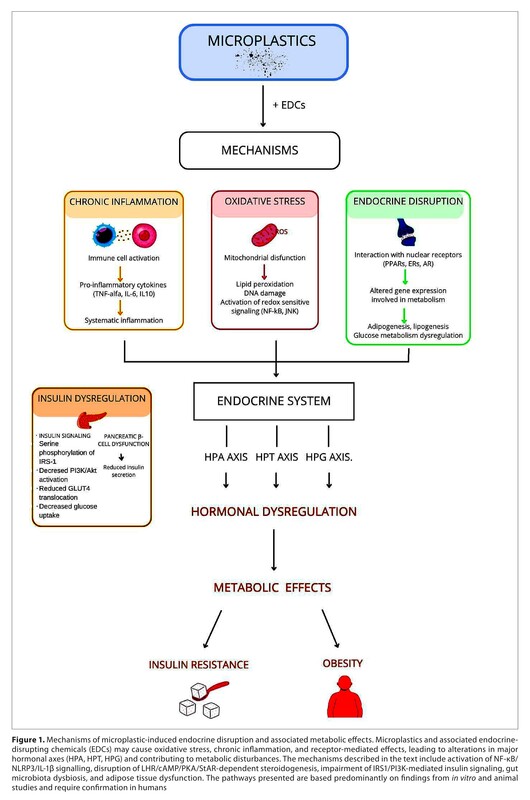
Available evidence suggests that microplastics may interfere with endocrine function through oxidative stress, inflammatory signalling, interactions with endocrine-disrupting chemicals, and disruption of intracellular pathways involved in hormone synthesis. Human bio-monitoring studies confirm internal exposure, whereas experimental studies provide mechanistic data on activation of inflammatory pathways, impairment of steroidogenesis, altered insulin signalling, gut microbiota dysbiosis, and adipose tissue dysfunction. These mechanisms may affect major hormonal axes, including the HPA, HPT, and HPG axes, and contribute to disturbances in glucose and lipid metabolism, insulin resistance, and obesity-related processes.
Summary:
Current data suggest that microplastics may act as potential modulators of endocrine and metabolic processes. However, most mechanistic evidence comes from in vitro and animal studies, and direct causal relationships between microplastic exposure and endocrine or metabolic diseases in humans remain unconfirmed. Further studies using standardized analytical methods, reliable contamination control, and clinically relevant endocrine and metabolic endpoints are needed.
Microplastics are widespread environmental contaminants, and their potential impact on human health has attracted increasing scientific attention. Due to their small size and physicochemical properties, they may enter the human body mainly through ingestion and inhalation, and have been detected in several biological matrices, including placenta, blood and lung tissue. The aim of this review is to summarise current knowledge on the endocrine-disrupting effects of microplastics and their potential metabolic consequences.
Brief description of the state of knowledge:
Available evidence suggests that microplastics may interfere with endocrine function through oxidative stress, inflammatory signalling, interactions with endocrine-disrupting chemicals, and disruption of intracellular pathways involved in hormone synthesis. Human bio-monitoring studies confirm internal exposure, whereas experimental studies provide mechanistic data on activation of inflammatory pathways, impairment of steroidogenesis, altered insulin signalling, gut microbiota dysbiosis, and adipose tissue dysfunction. These mechanisms may affect major hormonal axes, including the HPA, HPT, and HPG axes, and contribute to disturbances in glucose and lipid metabolism, insulin resistance, and obesity-related processes.
Summary:
Current data suggest that microplastics may act as potential modulators of endocrine and metabolic processes. However, most mechanistic evidence comes from in vitro and animal studies, and direct causal relationships between microplastic exposure and endocrine or metabolic diseases in humans remain unconfirmed. Further studies using standardized analytical methods, reliable contamination control, and clinically relevant endocrine and metabolic endpoints are needed.
INFORMACJE O RECENZOWANIU
Sprawdzono w systemie antyplagiatowym
REFERENCJE (27)
1.
Zimmermann L, Bartosova Z, Braun K, et al. Plastic products leach chemicals that induce in vitro toxicity under realistic use conditions. Environ Sci Technol. 2021;55(17):11814–11823. doi:10.1021/acs.est.1c01103.
2.
Leonard SVL, Liddle CR, Atherall CA, et al. Microplastics in human blood: polymer types, concentrations and characterisation using μFTIR. Environ Int. 2024;188:108751. doi:10.1016/j.envint.2024.108751.
3.
Ullah S, Ahmad S, Guo X, et al. A review of the endocrine disrupting effects of micro and nano plastic and their associated chemicals in mammals. Front Endocrinol (Lausanne). 2023 Jan 16;13:1084236. doi: 10.3389/fendo.2022.1084236. PMID: 36726457; PMCID: PMC9885170.
4.
Kusyk D, Górna I, Kowalówka M, et al. Microplastics in humans: a critical review of biomonitoring evidence and immune–metabolic associations. Appl Sci. 2025;15:12289. doi:10.3390/app152212289.
5.
Zeng G, Li J, Wang Y, et al. Polystyrene microplastic-induced oxidative stress triggers intestinal barrier dysfunction via the NF-κB/NLRP3/IL-1β/MCLK pathway. Environ Pollut. 2024 Mar 15;345:123473. doi:10.1016/j.envpol.2024.123473. Epub 2024 Jan 30. PMID: 38301820.
6.
Prüst M, Meijer J, Westerink RHS. The plastic brain: neurotoxicity of micro- and nanoplastics. Part Fibre Toxicol. 2020 Jun 8;17(1):24. doi: 10.1186/s12989-020-00358-y. PMID: 32513186; PMCID: PMC7282048.
7.
Prata JC, da Costa JP, Lopes I, et al. Environmental exposure to microplastics: an overview on possible human health effects. Sci Total Environ. 2020;702:134455. doi:10.1016/j.scitotenv.2019.134455.
8.
Anbumani S, Kakkar P. Ecotoxicological effects of microplastics on biota: a review. Environ Sci Pollut Res. 2018;25:14373–14396. doi:10.1007/s11356-018-1999-x.
9.
Rathee V, Ahlawat YK, Singh R, et al. Microplastics and health: a review on environmental exposure, toxicokinetics and biological effects. Sustainability. 2026;18:3527. doi:10.3390/su18073527.
10.
Daniel DB, Ashraf PM, Thomas SN, et al. Microplastics in the edible tissues of shellfishes sold for human consumption. Chemosphere. 2021;264(Pt 2):128554. doi:10.1016/j.chemosphere.2020.128554.
11.
Boucher J, Friot D. Primary microplastics in the oceans: a global evaluation of sources. Gland (Switzerland): International Union for Conservation of Nature; 2017. doi:10.2305/IUCN.CH.2017.01.en.
12.
Danopoulos E, Jenner LC, Twiddy M, et al. Microplastic Contamination of Seafood Intended for Human Consumption: A Systematic Review and Meta-Analysis. Environ Health Perspect. 2020 Dec;128(12):126002. doi:10.1289/EHP7171. Epub 2020 Dec 23. PMID: 33355482; PMCID: PMC7757379.
13.
Kosuth M, Mason SA, Wattenberg EV. Anthropogenic contamination of tap water, beer, and sea salt. PLoS One. 2018;13(4):e0194970. doi:10.1371/journal.pone.0194970.
14.
Mason SA, Welch VG, Neratko J. Synthetic polymer contamination in bottled water. Front Chem. 2018;6:407. doi:10.3389/fchem.2018.00407.
15.
Zuri G, Karanasiou A, Lacorte S. Microplastics: Human exposure assessment through air, water, and food. Environ Int. 2023 Sep;179:108150. doi:10.1016/j.envint.2023.108150. Epub 2023 Aug 14. PMID: 37607425.
16.
Sun A, Wang WX. Human exposure to microplastics and its associated health risks. Environ Health (Wash). 2023;1(3):139–149. doi:10.1021/envhealth.3c00053.
17.
Prata JC. Microplastics and human health: integrating pharmacokinetics. Crit Rev Environ Sci Technol. 2023;53(16):1489–1511. doi:10.1080/10643389.2023.2195798.
18.
Ragusa A, Svelato A, Santacroce C, et al. Plasticenta: First evidence of microplastics in human placenta. Environ Int. 2021 Jan;146:106274. doi:10.1016/j.envint.2020.106274. Epub 2020 Dec 2. PMID: 33395930.
19.
Garcia MA, Liu R, Nihart A, et al. Quantitation and identification of microplastics accumulation in human placental specimens using pyrolysis gas chromatography mass spectrometry. Toxicol Sci. 2024;199(1):81–88. doi:10.1093/toxsci/kfae021.
20.
Leslie HA, van Velzen MJM, Brandsma SH, et al. Discovery and quantification of plastic particle pollution in human blood. Environ Int. 2022 May;163:107199. doi: 10.1016/j.envint.2022.107199. Epub 2022 Mar 24. PMID: 35367073.
21.
Jenner LC, Rotchell JM, Bennett RT, et al. Detection of microplastics in human lung tissue using μFTIR spectroscopy. Sci Total Environ. 2022;831:154907. doi:10.1016/j.scitotenv.2022.154907.
22.
Kovacs K, Bodis J, Vass RA. Microplastics, endocrine disruptors, and oxidative stress: mechanisms and health implications. Int J Mol Sci. 2025;27(1):399. doi:10.3390/ijms27010399.
23.
Tyc HJ, Kłodnicka K, Teresińska B, et al. Micro- and nanoplastics as disruptors of the endocrine system—a review of the threats and consequences associated with plastic exposure. Int J Mol Sci. 2025;26(13):6156. doi:10.3390/ijms26136156.
24.
Jin H, Yan M, Pan C, et al. Chronic exposure to polystyrene microplastics induced male reproductive toxicity and decreased testosterone levels via the LH-mediated LHR/cAMP/PKA/StAR pathway. Part Fibre Toxicol. 2022;19(1):13. doi:10.1186/s12989-022-00453-2.
25.
Chen Q, Allgeier A, Yin D, et al. Leaching of endocrine disrupting chemicals from marine microplastics and mesoplastics under common life stress conditions. Environ Int. 2019;130:104938. doi:10.1016/j.envint.2019.104938.
26.
Huang D, Zhang Y, Long J, et al. Polystyrene microplastic exposure induces insulin resistance in mice via dysbacteriosis and pro-inflammation. Sci Total Environ. 2022;838(Pt 1):155937. doi:10.1016/j.scitotenv.2022.155937.
27.
Molonia MS, Trischitta S, Salamone FL, et al. In vitro effects of polystyrene microplastics exposure on adipose tissue dysfunction. Toxicol In Vitro. 2026;114:106220. doi:10.1016/j.tiv.2026.106220.
Udostępnij
ARTYKUŁ POWIĄZANY
| eISSN: | 2084-6312 |
| ISSN: | 1505-7054 |

Przetwarzamy dane osobowe zbierane podczas odwiedzania serwisu. Realizacja funkcji pozyskiwania informacji o użytkownikach i ich zachowaniu odbywa się poprzez dobrowolnie wprowadzone w formularzach informacje oraz zapisywanie w urządzeniach końcowych plików cookies (tzw. ciasteczka). Dane, w tym pliki cookies, wykorzystywane są w celu realizacji usług, zapewnienia wygodnego korzystania ze strony oraz w celu monitorowania ruchu zgodnie z Polityką prywatności. Dane są także zbierane i przetwarzane przez narzędzie Google Analytics (więcej).
Możesz zmienić ustawienia cookies w swojej przeglądarce. Ograniczenie stosowania plików cookies w konfiguracji przeglądarki może wpłynąć na niektóre funkcjonalności dostępne na stronie.
Możesz zmienić ustawienia cookies w swojej przeglądarce. Ograniczenie stosowania plików cookies w konfiguracji przeglądarki może wpłynąć na niektóre funkcjonalności dostępne na stronie.