Online first
Bieżący numer
O czasopiśmie
Archiwum
Polityka etyki publikacyjnej
System antyplagiatowy
Instrukcje dla Autorów
Instrukcje dla Recenzentów
Rada Redakcyjna
Bazy indeksacyjne
Komitet Redakcyjny
Recenzenci
2025
2024
2023
2022
2021
2020
2019
2018
Kontakt
Klauzula przetwarzania danych osobowych (RODO)

PRACA ORYGINALNA
Efektywność szkolnego programu rozwijania kompetencji emocjonalno-społecznych jako elementu środowiska psychospołecznego szkoły u dzieci ze spektrum autyzmu – pilotażowe badanie prospektywne pre-post
1
Poradnia Zdrowia Psychicznego dla Dzieci i Młodzieży/ Dział Interwencji Psychosomatycznej, Wojewódzki Szpital Specjalistyczny im. J. Gromkowskiego we Wrocławiu, Polska
Autor do korespondencji
Krzysztof Jarosław Niedziela
Poradnia Zdrowia Psychicznego dla Dzieci i Młodzieży / Dział Interwencji Psychosomatycznej, Wojewódzki Szpital Specjalistyczny im. J. Gromkowskiego we Wrocławiu, ul. Koszarowa 5, 51-149, Wrocław, Polska
Poradnia Zdrowia Psychicznego dla Dzieci i Młodzieży / Dział Interwencji Psychosomatycznej, Wojewódzki Szpital Specjalistyczny im. J. Gromkowskiego we Wrocławiu, ul. Koszarowa 5, 51-149, Wrocław, Polska
Med Srod. 2025;28(4):148-152

SŁOWA KLUCZOWE
DZIEDZINY
STRESZCZENIE
Wprowadzenie i cel:
Dzieci ze spektrum autyzmu (ASD) często doświadczają trudności w regulacji emocji i funkcjonowaniu społecznym w klasie, co może obniżać ich dobrostan oraz utrudniać współpracę rówieśniczą. Celem badania była ocena efektów krótkiego, szkolnego programu zajęć rozwijających kompetencje emocjonalno-społeczne u dzieci z ASD.
Materiał i metody:
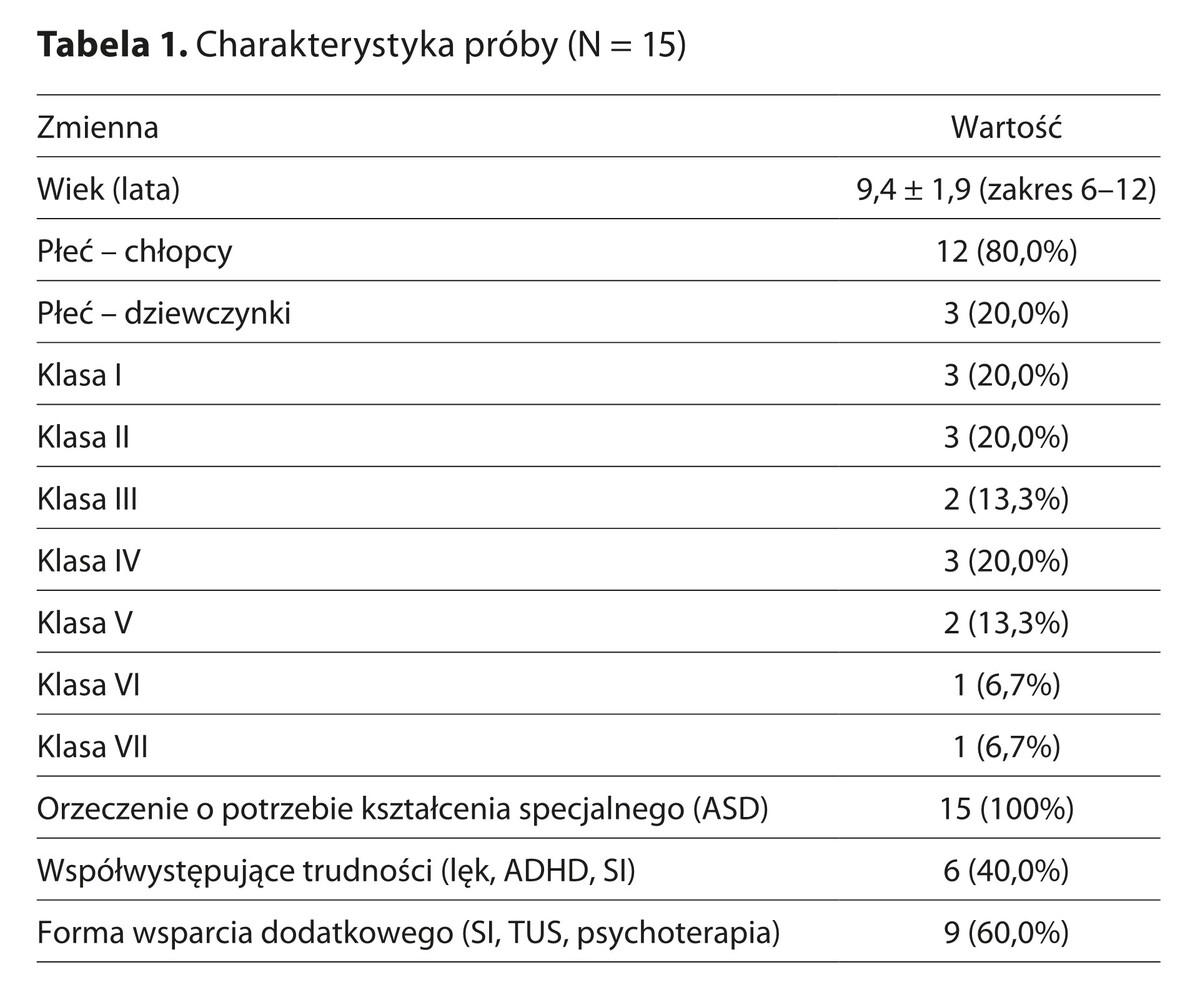
Przeprowadzono pilotażowe badanie prospektywne pre-post w grupie 15 uczniów (6–12 lat) z ASD. Program trwał 6 tygodni (18 spotkań, 3×/tydz., 45 min). Zastosowano: skalę VAS (0–10) do oceny nastroju i napięcia przed i po sesji (raz w tygodniu), KIDSCREEN-10 proxy (rodzic) w pomiarze T0 i T6 oraz arkusz obserwacyjny funkcjonowania podczas zajęć (0–24 pkt; T1 i T6). Analizę przeprowadzono testem Wilcoxona dla prób zależnych (α = 0,05).
Wyniki:
W analizie łącznej obejmującej wyniki z 6 tygodni stwierdzono istotny wzrost nastroju po zajęciach (średnio od 3,09 do 9,61 pkt) oraz spadek napięcia (od 3,16 do 0,33 pkt; oba p < 0,001). W ocenie rodziców poprawił się wynik jakości życia (KIDSCREEN-10: od 28,0 do 44,8 pkt; p < 0,001). W arkuszu obserwacyjnym odnotowano istotną poprawę funkcjonowania podczas zajęć (T1: od 10,8 do T6: 21,9 pkt; p < 0,001).
Wnioski:
Krótki, szkolny program rozwijania kompetencji emocjonalno-społecznych u dzieci z ASD był wykonalny i wiązał się z poprawą dobrostanu oraz obserwowanego funkcjonowania w grupie. Wyniki wymagają potwierdzenia w badaniu na większej próbie.
Dzieci ze spektrum autyzmu (ASD) często doświadczają trudności w regulacji emocji i funkcjonowaniu społecznym w klasie, co może obniżać ich dobrostan oraz utrudniać współpracę rówieśniczą. Celem badania była ocena efektów krótkiego, szkolnego programu zajęć rozwijających kompetencje emocjonalno-społeczne u dzieci z ASD.
Materiał i metody:
Przeprowadzono pilotażowe badanie prospektywne pre-post w grupie 15 uczniów (6–12 lat) z ASD. Program trwał 6 tygodni (18 spotkań, 3×/tydz., 45 min). Zastosowano: skalę VAS (0–10) do oceny nastroju i napięcia przed i po sesji (raz w tygodniu), KIDSCREEN-10 proxy (rodzic) w pomiarze T0 i T6 oraz arkusz obserwacyjny funkcjonowania podczas zajęć (0–24 pkt; T1 i T6). Analizę przeprowadzono testem Wilcoxona dla prób zależnych (α = 0,05).
Wyniki:
W analizie łącznej obejmującej wyniki z 6 tygodni stwierdzono istotny wzrost nastroju po zajęciach (średnio od 3,09 do 9,61 pkt) oraz spadek napięcia (od 3,16 do 0,33 pkt; oba p < 0,001). W ocenie rodziców poprawił się wynik jakości życia (KIDSCREEN-10: od 28,0 do 44,8 pkt; p < 0,001). W arkuszu obserwacyjnym odnotowano istotną poprawę funkcjonowania podczas zajęć (T1: od 10,8 do T6: 21,9 pkt; p < 0,001).
Wnioski:
Krótki, szkolny program rozwijania kompetencji emocjonalno-społecznych u dzieci z ASD był wykonalny i wiązał się z poprawą dobrostanu oraz obserwowanego funkcjonowania w grupie. Wyniki wymagają potwierdzenia w badaniu na większej próbie.
Introduction and objective:
Children with autism spectrum disorder (ASD) often experience difficulties in social communication and emotion regulation, which may negatively affect their quality of life and participation in school activities. The aim of this pilot study is to assess the effectiveness and feasibility of a 6-week school-based socio-emotional skills programme as a component of the psychosocial school environment in children with ASD.
Material and methods:
A prospective pre–post observational study was conducted among 15 schoolchildren with ASD (N = 15) aged 6–12. The programme was carried out in October–November, 2025, and lasted 6 weeks (18 sessions, 3 × 45 minutes per week). Outcomes included weekly use of the Visual Analogue Scales (VAS) assessing mood and tension before and after sessions, the parent-reported KIDSCREEN-10 proxy questionnaire administered at baseline (T0) and post-intervention (T6), as well as the therapist-rated observation sheet completed at baseline (T1) and post-intervention (T6). The analysis was performed using the Wilcoxon matched-pairs signed-rank test (α=0.05).
Results:
The 6-week combined analysis showed that the mean mood scores increased from 3.09 ± 0.87–9.61 ± 0.53, while mean tension scores decreased from 3.16 ± 0.60–0.33 ± 0.24 (p < 0.001 each). The KIDSCREEN-10 proxy total score increased from 28.0–44.8 (p < 0.001). The total score on the observation sheet improved from 10.8–21.9 (p < 0.001). The programme was feasible and well accepted by participants and their families.
Conclusions:
Participation in a brief school-based socio-emotional skills programme was associated with improved mood, reduced tension, and better parent-reported quality of life in children with ASD. Further studies with larger samples, control groups, and follow-up assessments are needed to confirm these findings.
Children with autism spectrum disorder (ASD) often experience difficulties in social communication and emotion regulation, which may negatively affect their quality of life and participation in school activities. The aim of this pilot study is to assess the effectiveness and feasibility of a 6-week school-based socio-emotional skills programme as a component of the psychosocial school environment in children with ASD.
Material and methods:
A prospective pre–post observational study was conducted among 15 schoolchildren with ASD (N = 15) aged 6–12. The programme was carried out in October–November, 2025, and lasted 6 weeks (18 sessions, 3 × 45 minutes per week). Outcomes included weekly use of the Visual Analogue Scales (VAS) assessing mood and tension before and after sessions, the parent-reported KIDSCREEN-10 proxy questionnaire administered at baseline (T0) and post-intervention (T6), as well as the therapist-rated observation sheet completed at baseline (T1) and post-intervention (T6). The analysis was performed using the Wilcoxon matched-pairs signed-rank test (α=0.05).
Results:
The 6-week combined analysis showed that the mean mood scores increased from 3.09 ± 0.87–9.61 ± 0.53, while mean tension scores decreased from 3.16 ± 0.60–0.33 ± 0.24 (p < 0.001 each). The KIDSCREEN-10 proxy total score increased from 28.0–44.8 (p < 0.001). The total score on the observation sheet improved from 10.8–21.9 (p < 0.001). The programme was feasible and well accepted by participants and their families.
Conclusions:
Participation in a brief school-based socio-emotional skills programme was associated with improved mood, reduced tension, and better parent-reported quality of life in children with ASD. Further studies with larger samples, control groups, and follow-up assessments are needed to confirm these findings.
REFERENCJE (22)
1.
American Psychiatric Association. Diagnostic and statistical manual of mental disorders. 5th ed, text revision (DSM-5-TR). Washington (DC): American Psychiatric Association; 2022.
2.
Minister Edukacji Narodowej. Rozporządzenie w sprawie zasad udzielania i organizacji pomocy psychologiczno-pedagogicznej w publicznych przedszkolach, szkołach i placówkach. DzU 2017 poz. 1591.
3.
Winczura B. Dziecko z autyzmem. Terapia deficytów poznawczych a teoria umysłu. Kraków: Oficyna Wydawnicza Impuls; 2019.
5.
Watkins L, Ledbetter-Cho K, O’Reilly M, et al. Interventions for students with autism in inclusive settings: a best-evidence synthesis and meta-analysis. Psychol Bull. 2019;145(5):490–507. doi:10.1037/bul0000190.
6.
Wolstencroft J, Robinson L, Srinivasan R, et al. A systematic review of group social skills interventions, and meta-analysis of outcomes, for children with high functioning autism spectrum disorder. J Autism Dev Disord. 2018;48(7):2293–2307. doi:10.1007/s10803-018-3485-1.
7.
Sutton BM, Webster AA, Westerveld MF. A systematic review of school-based interventions targeting social communication behaviors for students with autism. Autism. 2019;23(2):274–286. doi:10.1177/1362361317753564.
8.
Maenner MJ, Warren Z, Williams AR, et al. Prevalence and characteristics of autism spectrum disorder among children aged 8 years — Autism and Developmental Disabilities Monitoring Network, 11 sites, United States, 2020. MMWR Surveill Summ. 2023;72(2):1–14. doi:10.15585/mmwr.ss7202a1.
9.
World Health Organization. Autism. Geneva: World Health Organization; 2023. Available from: https://www.who.int/news-room/....
10.
Zeidan J, Fombonne E, Scorah J, et al. Global prevalence of autism: a meta-analysis. Mol Psychiatry. 2022;27(5):1966–1977. doi:10.1038/s41380-021-01107-7.
11.
Northrup JB, Hartman AG, MacKenzie KT, et al. Emotion dysregulation in autism: severity and correlates in early childhood. Autism Res. 2024;17(12):2662–2675. doi:10.1002/aur.3264.
12.
Hume K, Steinbrenner JR, Odom SL, et al. Evidence-based practices for children, youth, and young adults with autism: third generation review. J Autism Dev Disord. 2021;51(11):4013–4032. doi:10.1007/s10803-020-04844-5.
13.
Odom SL, Collet-Klingenberg L, Rogers SJ, Hatton DD. Evidence-based practices in interventions for children and youth with autism spectrum disorders. Prev Sch Fail. 2010;54(4):275–282. doi:10.1080/10459881003785506.
14.
Restoy D, Oriol-Escudé M, Alonzo-Castillo T, et al. Emotion regulation and emotion dysregulation in children and adolescents with Autism Spectrum Disorder: a meta-analysis of evaluation and intervention studies. Clin Psychol Rev. 2024;109:102410. doi:10.1016/j.cpr.2024.102410.
15.
Aitken RC. Measurement of feelings using visual analogue scales. Proc R Soc Med. 1969;62(10):989–993.
16.
Befus EG, Helseth S, Mølland E, et al. Use of KIDSCREEN health-related quality of life instruments in the general population of children and adolescents: a scoping review. Health Qual Life Outcomes. 2023;21(1):6. doi:10.1186/s12955-023-02088-z.
17.
Ravens-Sieberer U, Erhart M, Rajmil L, et al. Reliability, construct and criterion validity of the KIDSCREEN-10 score: a short measure for children’s and adolescents’ well-being and health-related quality of life. Qual Life Res. 2010;19(10):1487–1500. doi:10.1007/s11136-010-9706-5.
18.
Watkins L, Kuhn M, Ledbetter-Cho K, et al. Evidence-based social communication interventions for children with autism spectrum disorder. Indian J Pediatr. 2017;84(1):68–75. doi:10.1007/s12098-015-1938-5.
19.
Cai RY, Richdale AL, Dissanayake C, et al. Emotion regulation in autism spectrum disorder: where we are and where we need to go. Autism Res. 2019;12(11):1558–1573. doi:10.1002/aur.2155.
20.
Narzisi A, Sesso G, Fabbri-Destro M, et al. Social skills interventions for adolescents with Level 1 Autism Spectrum Disorder: a systematic review with meta-analysis of randomized controlled trials. Clin Neuropsychiatry. 2024;21(3):169–181. doi:10.36131/cnfioritieditore20240302.
21.
McDonald RG, Cargill MI, Khawar S, Kang E. Emotion dysregulation in autism: a meta-analysis. Autism. 2024;28(12):2986–3001. doi:10.1177/13623613241257605.
22.
Field A. Discovering statistics using IBM SPSS statistics. 5th ed. London: SAGE Publications; 2018.
| eISSN: | 2084-6312 |
| ISSN: | 1505-7054 |

Przetwarzamy dane osobowe zbierane podczas odwiedzania serwisu. Realizacja funkcji pozyskiwania informacji o użytkownikach i ich zachowaniu odbywa się poprzez dobrowolnie wprowadzone w formularzach informacje oraz zapisywanie w urządzeniach końcowych plików cookies (tzw. ciasteczka). Dane, w tym pliki cookies, wykorzystywane są w celu realizacji usług, zapewnienia wygodnego korzystania ze strony oraz w celu monitorowania ruchu zgodnie z Polityką prywatności. Dane są także zbierane i przetwarzane przez narzędzie Google Analytics (więcej).
Możesz zmienić ustawienia cookies w swojej przeglądarce. Ograniczenie stosowania plików cookies w konfiguracji przeglądarki może wpłynąć na niektóre funkcjonalności dostępne na stronie.
Możesz zmienić ustawienia cookies w swojej przeglądarce. Ograniczenie stosowania plików cookies w konfiguracji przeglądarki może wpłynąć na niektóre funkcjonalności dostępne na stronie.